We’re not building software anymore. Not in any sense that matters. What’s emerging isn’t a better category of software — it’s a different category of object, and the entire discipline that organized itself around the old category is about to discover that it was built on a constraint that no longer exists.
Software, as a discipline, existed for one reason. Machines could not interpret intent. Every artifact the discipline produced — interfaces, workflows, data models, sprints, design systems, the whole apparatus — was a way of pre-translating the world into structures rigid enough for a machine to execute. The interface was not the goal. The interface was the price we paid for translation. This was so universal that it became invisible. We stopped seeing UX as compensation and started seeing it as craft. We stopped seeing the modeling phase of a project as a constraint and started seeing it as professionalism. The discipline mistook its own contortion for its own value.
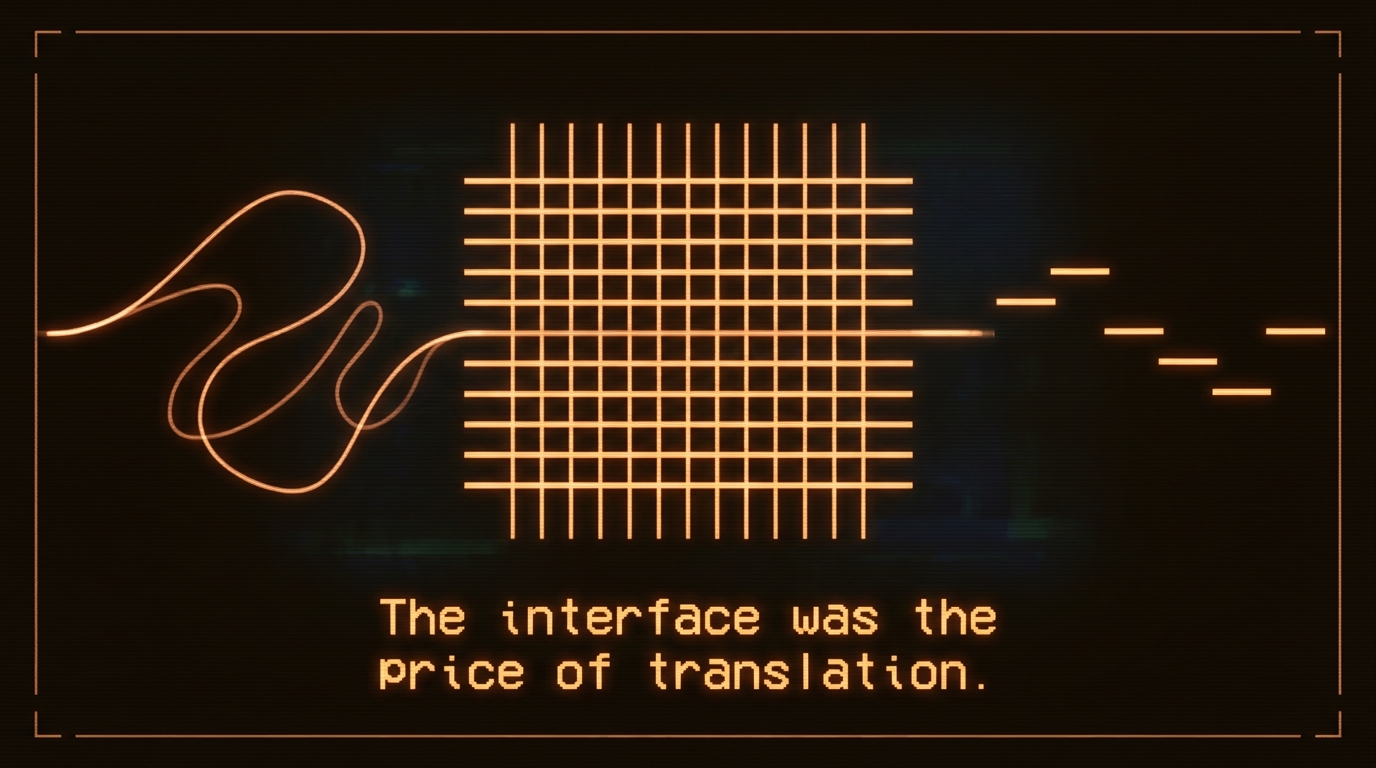
That constraint is gone. Language has become the substrate. A model can now read an intent expressed in natural prose, parse it against a body of knowledge, and produce a result without any of the compensation layer that the old discipline insisted was necessary. The translation step — the part the entire industry was organized to perform — is no longer load-bearing.
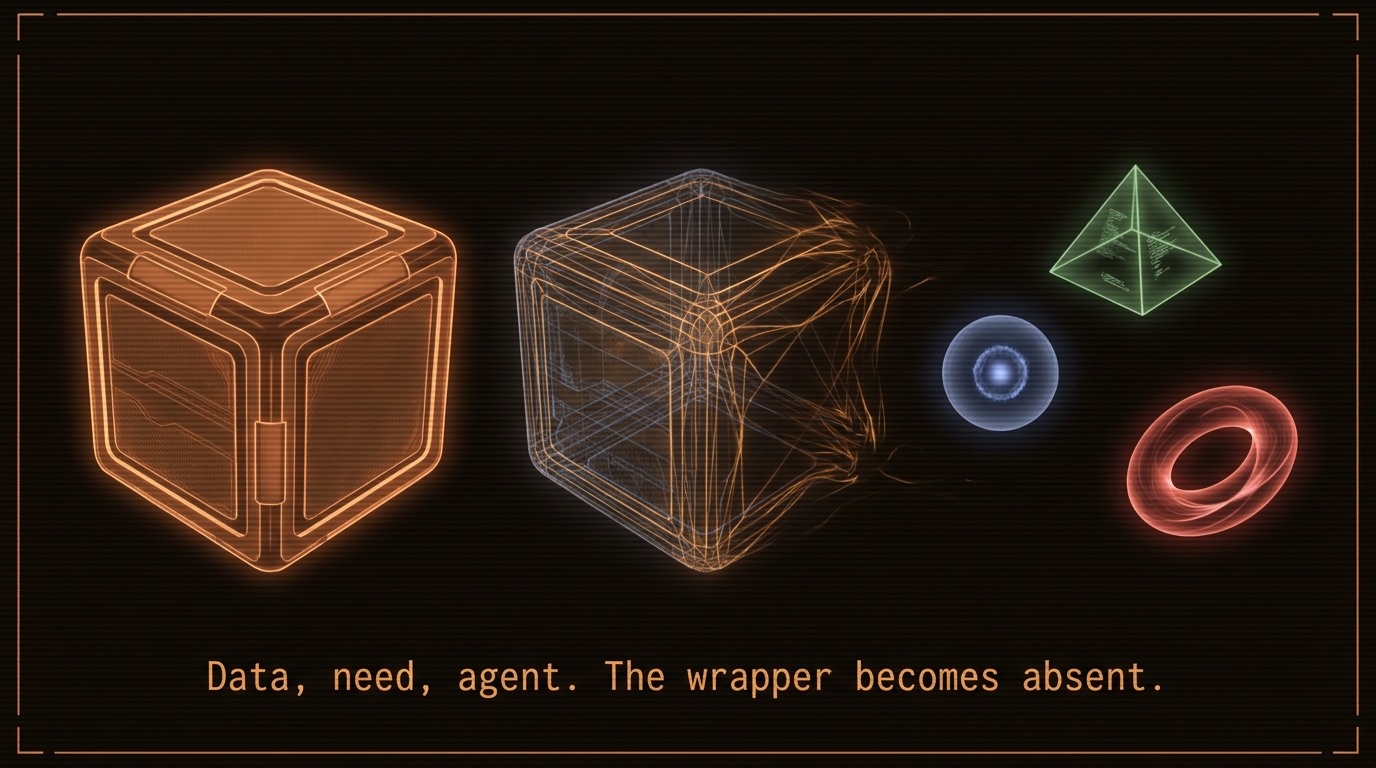
What’s left when you remove the compensation layer is strange. The application as a monolithic object — the thing with a name, an interface, a defined set of functions — starts to dissolve. In its place, three primitives become legible: a body of knowledge, a stated need, an agent capable of acting on the first to satisfy the second. These are not components of an application. They are what an application was always trying to bind together, awkwardly, through code. The application was the necessary intermediary as long as the machine could not see the binding directly. Now it can. The binding becomes the unit of work. The wrapper around it — what we used to call software — becomes optional, and then absent.
A conceptual shift of this magnitude would remain theoretical if the cost of acting on it stayed high. It will not. The cost of inference is collapsing on a curve that has not yet stabilized, and per-query construction — generating an image, composing a layout, rendering a video, assembling a response — is approaching effective zero. What was previously economically unthinkable, building a fresh artifact for each user request, is becoming a default option. The three primitives only replace the monolithic application if the cost of materializing a result per request is negligible. That condition is being met. The paradigm becomes operational, not aspirational.
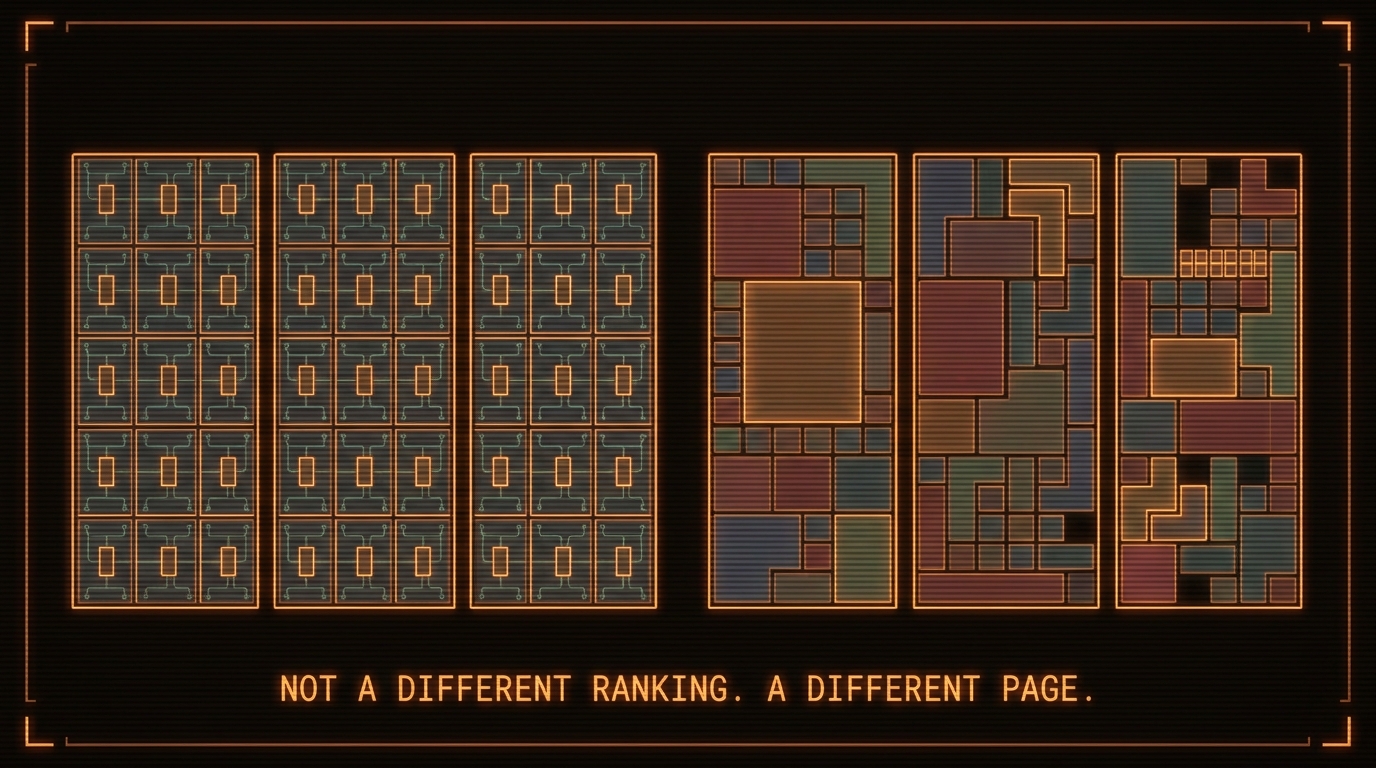
Consider a user typing “I want a coat” into Amazon. Today, this returns a generic results page: filters on the left, a grid of products in the middle, sponsored placements at the top — the same template every other user sees. The interface assumes the user does not know exactly what they want and offers a fixed set of refinement tools to help them converge. The new version does not begin with a template. It begins with the stated need and two or three clarifying questions — climate, style register, price ceiling. From those answers, the page is composed: image suggestions tuned to the user’s expressed taste, trend modules surfaced because they are relevant to this user’s situation, a short personalized video, a navigation structure built for this intention. The same query from a different user produces a different page — not a different ranking, a different page. The site as a stable artifact is gone. What remains is a constructor that produces a fresh artifact per request and discards it after use.
This is the actual shape of the next step. Not “AI-powered applications,” which is a phrase that still belongs to the old category — software with an AI feature bolted on. The new object is software that does not exist before it is needed. It is composed module by module to satisfy a declared intent, runs as long as the intent is active, and dissolves when the intent is satisfied. There is no installed base, no version, no roadmap in the old sense. There is a corpus, an intention, and a constructor.
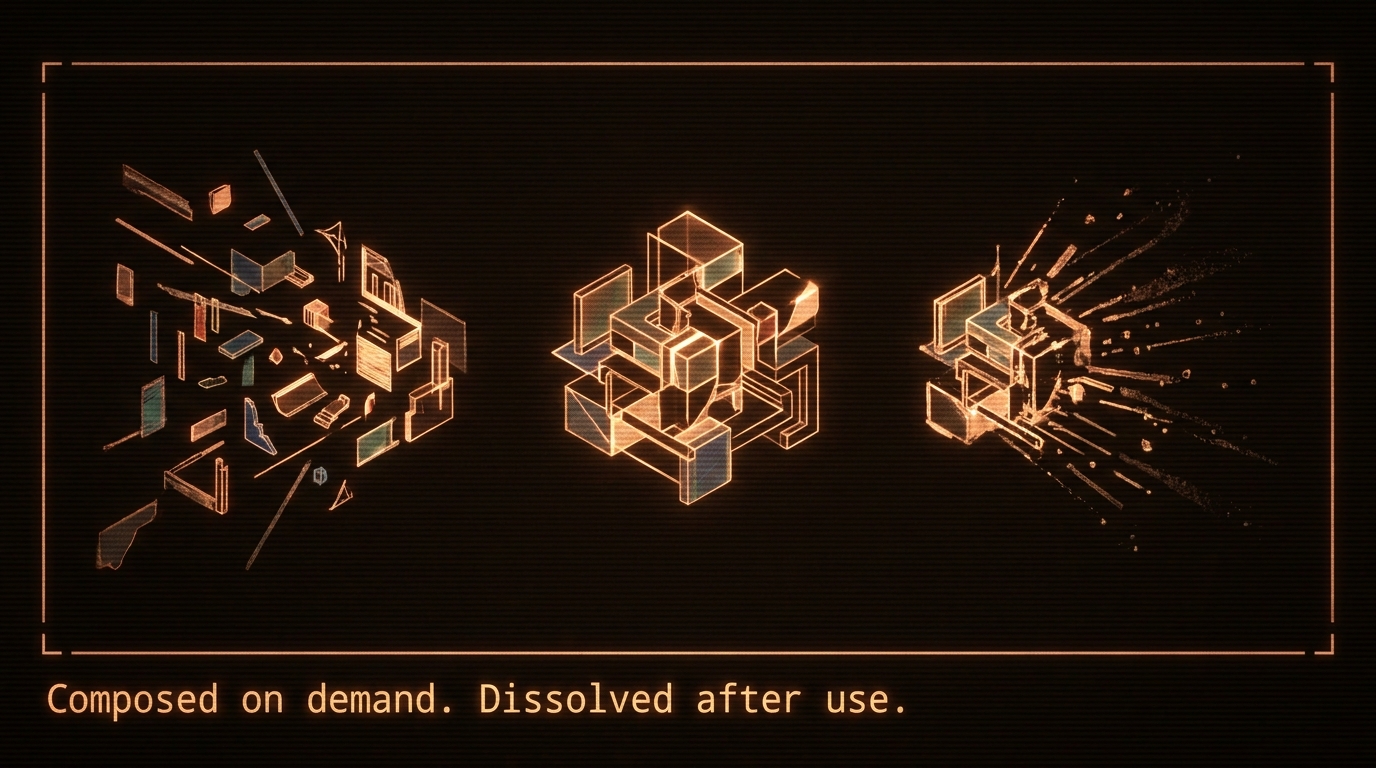
The implications for what we used to call software development are not subtle. Designing interfaces becomes an architectural exercise about which modules a constructor can compose, not an exercise about which screens a user will navigate. Project management is no longer scoped around shipping a product; it is scoped around defining the corpus and the constructor’s repertoire. UX is no longer a discipline of designing flows; it is a discipline of designing what the constructor can build in response to a class of needs.
The software era is ending. Not because software is being replaced by something better in the same category, but because the category itself was a workaround for a constraint that no longer applies. What replaces it is defined by intent rather than interface, composed on demand rather than shipped, and architected as a constructor rather than a product. The discipline that built itself around interfaces was always built on borrowed time. The time is up.