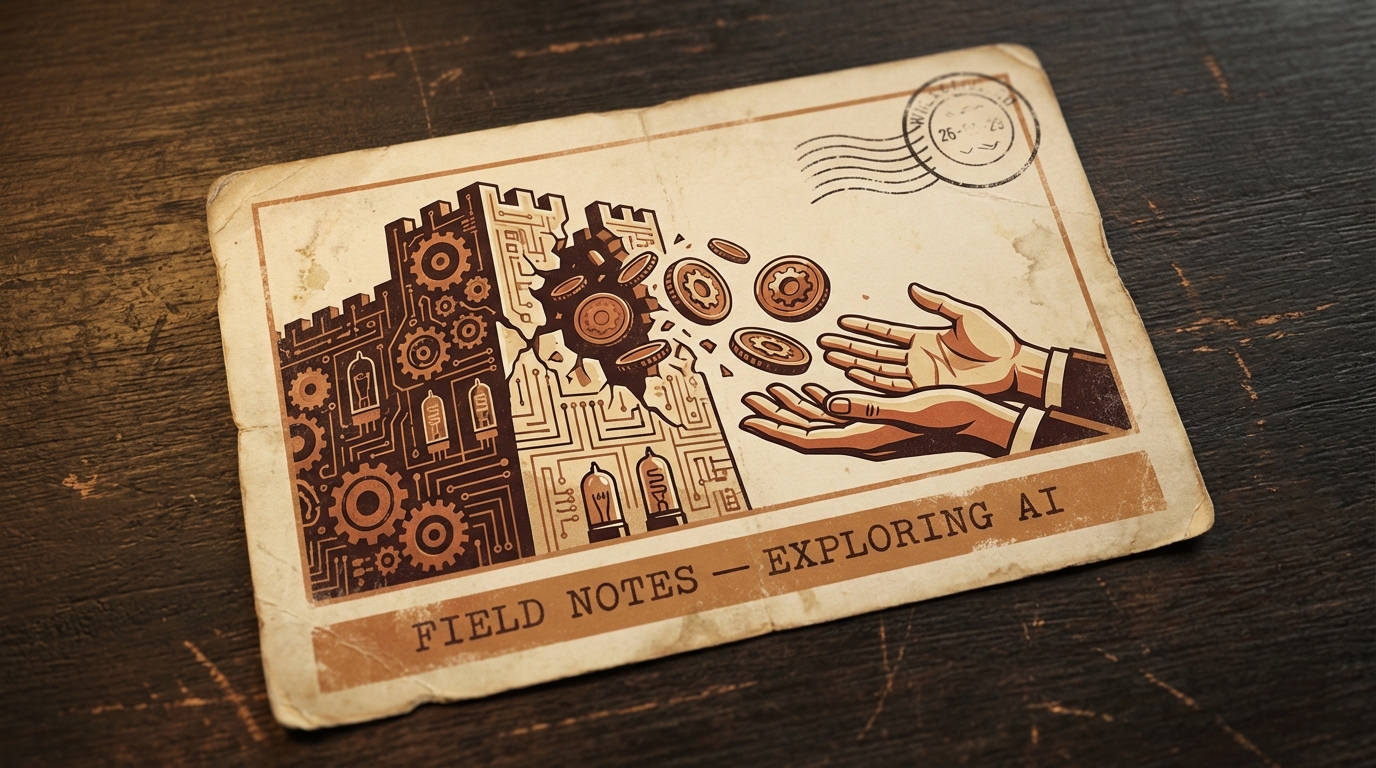
For a long time, access to certain technologies or skills acted as a barrier to entry for creating innovative products or services. You needed technical teams, deep expertise, sometimes years of experience to turn an idea into a working prototype. But recent history shows that some technologies always end up being commoditized—made accessible to everyone to the point that they no longer represent a differentiating advantage.
When Technology Becomes Commonplace… and Equalizing
Take a simple example: a smartphone. The richest person in the world doesn’t have access to a “better” iPhone than anyone else. He can buy satellites, rockets, companies—but not a phone that surpasses the one you can buy for $1,000. Some consumer technologies reach a level where spending more won’t change anything: the ultimate phone is available to all.
This phenomenon is now spreading to another field: artificial intelligence. Tools like ChatGPT, Midjourney, Runway, and the Vibe Coding (used to build web apps through assisted design) now make skills that were once reserved for experts accessible to everyone. And this accessibility isn’t marginal—it is radically transformative.
Toward the Commoditization of Intelligence
Today, AI allows users without deep technical training to:
- design an app prototype,
- generate graphic or sound assets for a game,
- automate complex tasks,
- write scripts or code,
- and iterate faster than ever before.
This means technical skill is no longer always the scarce resource. Just a few years ago, a founder needed a CTO or a technical team from day one. Now, they can test an idea, build an MVP (Minimum Viable Product), and validate a market on their own or almost. This deeply reshapes the innovation landscape.
And this shift already has concrete consequences. More and more investors are looking not at a founder’s ability to code, but at their domain expertise, execution, and product vision. The rare skill is no longer building the tools—it’s knowing how to use them smartly.
A New Distribution of Creative Power
In the game development world, this opens up fascinating possibilities. A small team—or even a single person—can:
- generate cohesive visuals,
- create dynamic music,
- design gameplay systems,
- test gameplay loops with AI,
- and even build adaptive narrative systems.
And this shift doesn’t only concern the indie scene. Of course, we’ll see new types of projects emerge from a wide variety of creators. But the very structure of production organizations will also need to evolve. It is now possible to delegate content creation to quasi-autonomous cells, accelerating iteration, reducing coordination costs, and enhancing agility.
A New Balance to Strike
The commoditization of intelligence doesn’t mean everyone becomes equally skilled, but rather that smart tools lower the barrier to entry. Good ideas, when paired with the right execution, can go much further with much less. This redistributes the cards: skills become more transversal, creativity takes center stage, and the ability to combine vision, execution, and iteration becomes the true driver of success.
This structural shift forces us to rethink traditional criteria: who has talent? who brings value? who deserves investment? Yesterday’s answers are no longer enough.