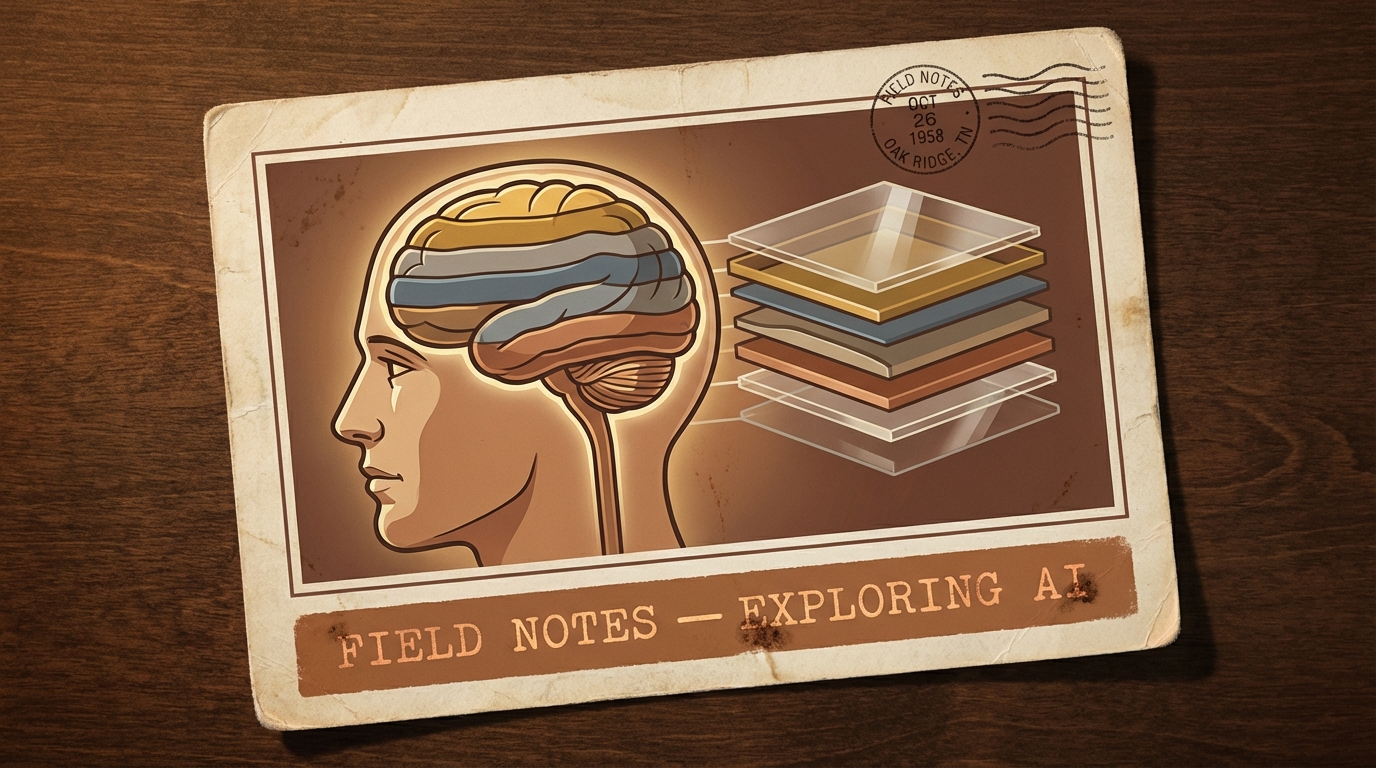
The evolution of Large Language Models (LLMs) isn’t just about making them bigger or faster. What we’re witnessing today is the emergence of a layered cognitive structure—one that increasingly mirrors the architecture of the human brain.
The Core Model: A “Median Brain”
Pretrained LLMs like GPT, Claude, or Mistral are trained on vast, general-purpose corpora. The result is a kind of collective long-term memory, a generalized intelligence—what we might call a “median brain”:
- capable of understanding language,
- reasoning across broad contexts,
- but lacking deep specialization in any one domain.
This general knowledge is powerful, but necessarily compressed. It represents an efficient approximation of human knowledge, not an exhaustive, domain-level understanding.
The Context Window: More Than Just Working Memory
When we use an LLM, we supply a context—limited by the token window—that helps the model “focus” on the problem at hand.
This inference context functions like a working memory, but it’s more powerful than a simple buffer:
- It allows dynamic integration of task-specific information.
- Through RAGs (Retrieval-Augmented Generation), we can inject relevant documents, data, or user-specific inputs directly into the reasoning process.
Rather than encoding this knowledge into the model itself, we bring it in at runtime—just like a human consulting a notebook or a search engine. This context acts like episodic memory, or consultative memory: situational, temporary, but crucial for focused thinking.
Modality and Specialization: Like Functional Areas of the Brain
Here’s where things get even more interesting. We’re moving toward orchestrated systems of models, rather than relying on a single monolithic model.
This architecture mirrors the functional specialization of the brain:
- A primary model identifies the task and delegates.
- Specialized sub-models are called in: a coding expert model, a visual model, a medical model, etc.
- The results are then synthesized or adapted by the coordinator model.
Each model is smaller and more efficient, optimized for a specific domain. This is like how the brain has different regions for language, vision, motor control, and memory—distributed cognition with coordinated outputs.
Compression vs Precision: A Critical Tradeoff
When you train a single model on the entirety of human knowledge, you must compress. But in high-stakes domains like healthcare or law, this compression introduces risk—it can lead to hallucinations or loss of nuance.
To address this, two strategies emerge:
- Fine-tuning specialized models on domain-specific corpora, ensuring precision without dilution.
- Keeping domain knowledge external, using tools like RAGs to inject it into context when needed—without forcing it into the base model.
In other words, precision demands either specialization or externalization.
What Comes Next? Toward a Systemic, Distributed Intelligence
If we follow this logic, LLMs are no longer just monolithic predictors—they’re evolving into composite cognitive systems. The future likely includes:
1. Networks of Specialized Agents
Where a general model identifies the task and routes it to a specialized model:
- Code generation goes to a coding model.
- Visual interpretation to a vision model.
- Legal advice to a legal model.
These models don’t just coexist—they communicate, collaborate, and delegate.
2. Persistent Contexts and Long-Term Memory
Right now, context resets between sessions. But future systems may build long-term user memory:
- remembering preferences,
- tracking ongoing projects,
- adapting tone, style, and expertise level.
This memory isn’t global—it’s user-specific, like a smart assistant who knows you.
3. Embodied Intelligence in Roles
Combine specialization, memory, and task orchestration, and you get role-based agents:
- A virtual doctor who knows your history.
- A financial analyst who tracks your portfolio.
- A narrative guide that remembers your choices in a game world.
These are not general-purpose AIs—they’re tailored personas, intelligent in their own domains, persistent in their context.
Conclusion: Toward Living, Modular Intelligence
We are witnessing a shift from monolithic AI to living, stratified systems—with parallels to biological cognition:
- Layered memory (short-term, long-term, external);
- Specialization and division of labor;
- Contextual reasoning and orchestration.
In this future, intelligence isn’t just larger. It’s organized. It’s composite. It’s contextual.
Not a massive brain in a box, but a network of thinking parts—designed to adapt, specialize, and evolve.
And perhaps the real leap won’t be a bigger model, but a smarter system.