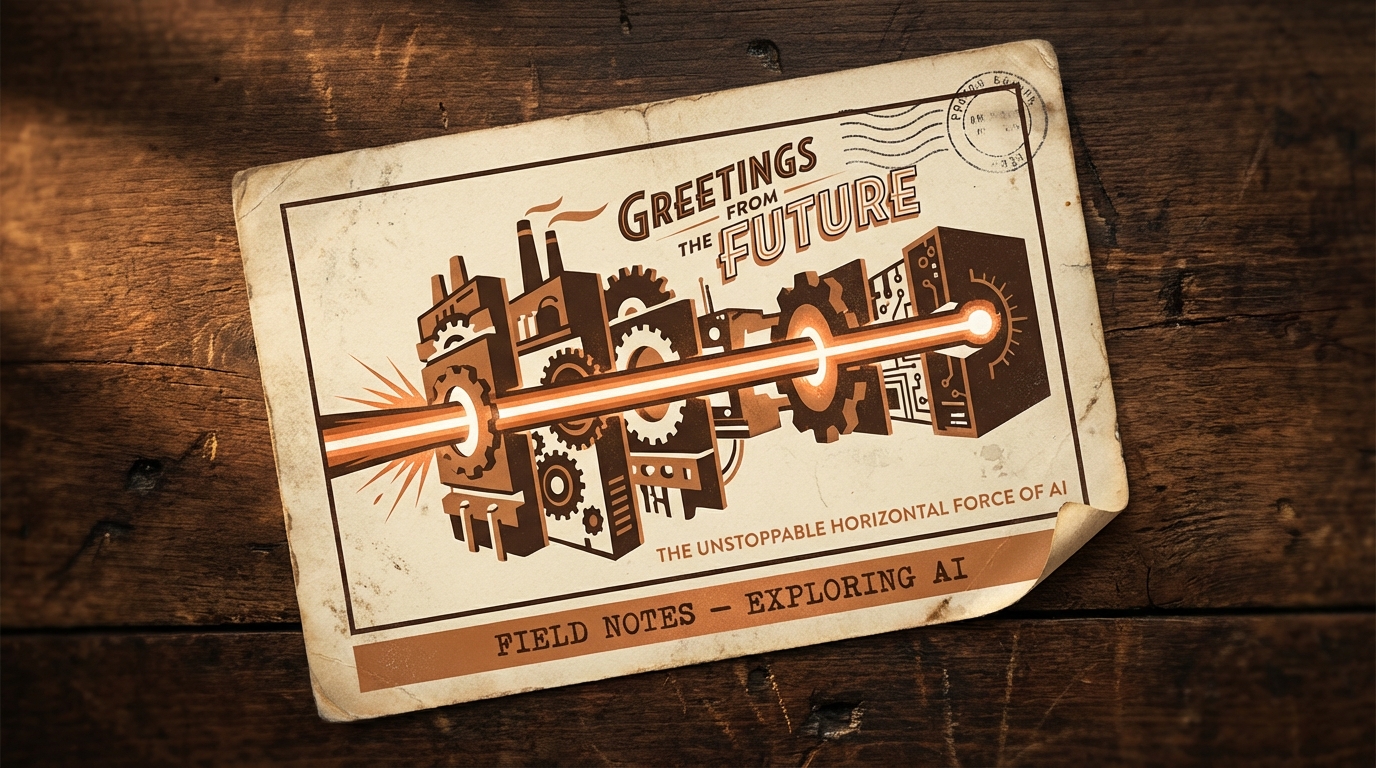
Artificial intelligence technologies aren’t like other tools. They don’t target a specific sector or task — they’re horizontal technologies. In other words, they cut across all domains, transforming practices at every stage of the production chain and fundamentally changing the way we work. Their impact is systemic.
AI as a Partial Automation Engine
What these tools automate are often the technical, repetitive tasks — the replicable elements. What remains for us to handle are the things that can’t easily be formalized: meaning, context, judgment, and intention. This is what we might call the “meta” of the job.
Understanding this meta is becoming crucial — it’s what separates a doer from an expert. Every job has a surface layer — tools, deliverables, processes — and a deeper layer made of choices, direction, systemic understanding. That’s the layer AI doesn’t yet master.
Concrete Examples of This Shift
Take project management, for instance. It’s not about ticking boxes in a project tracking tool. A real project manager analyzes risks, understands what’s at stake, navigates constraints, and makes informed decisions. Administrative tasks can be handed off to an AI. What can’t be is the ability to anticipate, to arbitrate.
Same goes for an artist. AI can generate images, concepts, infinite variations. But choosing the one that fits a coherent artistic vision — that aligns with gameplay constraints, technical limitations, and world-building — that’s a task of direction and judgment.
Or take a developer. Writing code isn’t the core skill anymore. Understanding the problem is. AI can write the syntax, but someone still needs to frame the question properly, define a relevant solution, and integrate it in a smart, scalable way. That’s where the value lies.
The Real Shift: A Productivity Explosion
These tools don’t replace people. People who use them effectively replace those who don’t. The productivity leap is so dramatic that it redefines what individuals can accomplish. A AAA title that required 2,500 people over five years might soon be achievable with 500.
This raises a key question: What do we do with that productivity gain? Do we make more games? Shorten production cycles? Redefine team sizes? Rethink how we distribute value? These are economic and cultural choices we’ll have to make.
A World of Creators… But Fewer Entry Points
Paradoxically, creators have never had so much power — and yet newcomers may find it harder than ever to enter the field. AI tools are outstanding assistants… and traditionally, assistant-level work was how people got their foot in the door.
In the past, many people entered the industry through QA. But with the rise of specialized game schools, this traditional entry point has narrowed or even closed. Now, junior artists, developers, and other entry-level roles face a similar bottleneck. The path forward may start to resemble that of cinema: aspiring creators will have to produce their own small games, post them online, hope to go viral, and get noticed.
A Broader Shift — Not Just in Games
Most importantly, this isn’t just about the games industry. This is society-wide. From accounting to education, law to communication, any job built on repetition or formalism is at risk of deep transformation.
This is not a crisis of a sector — it’s a paradigm shift. Those who understand the new dynamics, reinvent their approach, and position themselves intelligently will thrive. Others may find their roles automated… or simply replaced by someone who knows how to wield AI more effectively.