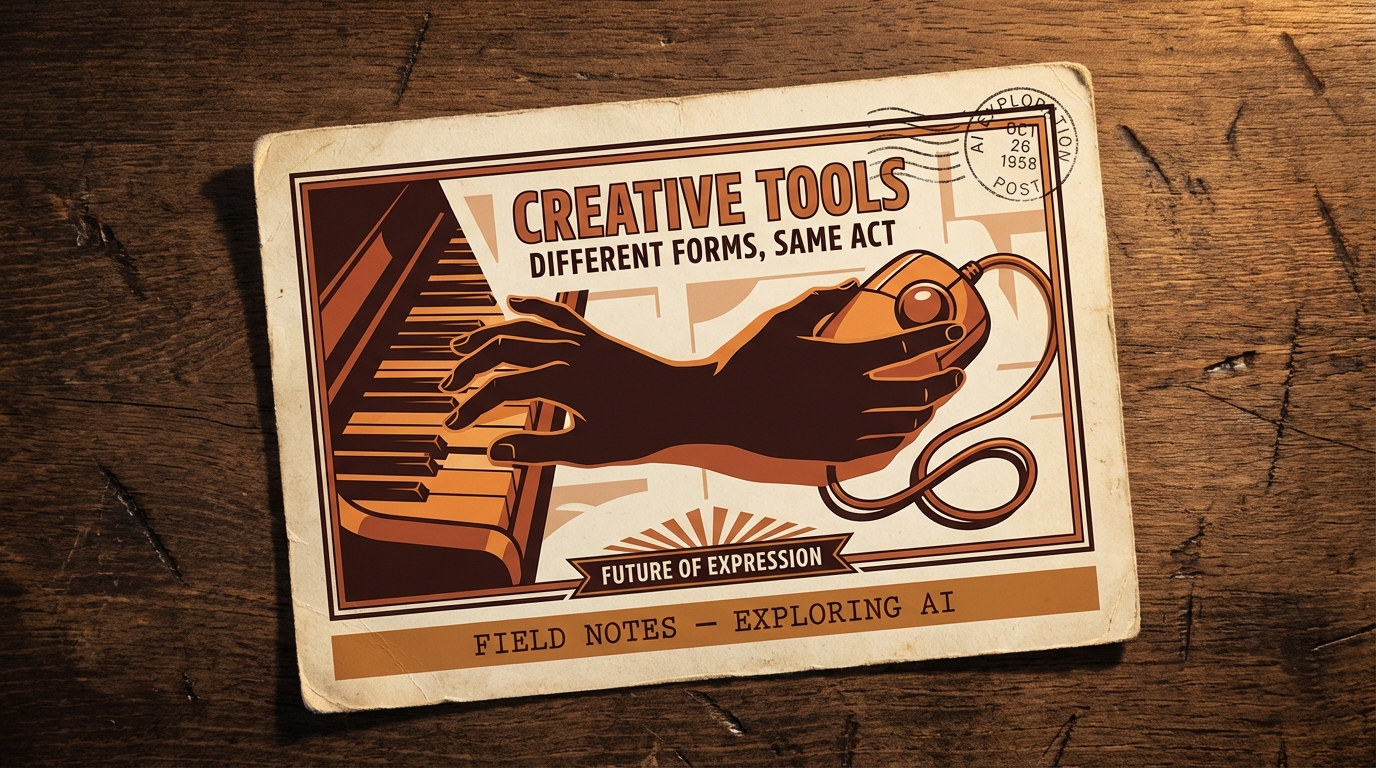
Every creative revolution comes with its share of resistance.
When home studios emerged in the ’80s and ’90s, many classically trained musicians pushed back: “These people aren’t real musicians,” “They can’t even play an instrument,” “There’s no soul in it.”
Today, those exact same arguments are being made about generative AI — especially in visual arts.
This isn’t just déjà vu — it’s a deep pattern in how humans react to tools that shift power, skills, and value in creative production.
1. The Eternal Fear of Shortcuts
Whenever a new tool offers a shortcut to something that once required years of training, the first reaction is rejection.
It’s not irrational — watching someone bypass a hard-earned skill with a few clicks can be infuriating.
- DJs and beatmakers were dismissed for not “really playing” music.
- Digital artists were mocked for relying on CTRL-Z and layers.
- GenAI users are now criticized for not “really drawing.”
But history shows that as the tools mature, and as users evolve from casuals to artists in their own right, respect catches up — eventually.
2. Skill Still Matters
Just because the tools are easy doesn’t mean the craft disappears.
- Great electronic musicians still need to understand harmony, rhythm, texture.
- Skilled GenAI users need to grasp composition, style, lighting, storytelling.
AI doesn’t replace taste, culture, or vision.
It just shifts the skillset from execution to direction — from “doing everything yourself” to “orchestrating with intent.”
3. Automation Redefines Where the Value Is
In creative industries — especially games — GenAI isn’t about replacing artists.
It’s about freeing up time from repetitive or low-impact tasks, to focus human energy on what matters most:
- Narrative beats
- Gameplay systems
- Emotional impact
- Artistic cohesion
It’s not about making everything faster. It’s about being smarter about where the human touch really matters.
4. The Audience Judges the Result, Not the Process
And here lies the core issue.
The resistance is natural, but it doesn’t stop adoption.
Most consumers simply don’t care whether something was made by hand or AI.
They want it to look good, feel coherent, and be enjoyable.
In card games, visual novels, or illustrated content, thousands of assets are now AI-generated—and the reaction? Silence.
Not because no one notices—but because most people don’t mind.
As seen with Lofi playlists on Spotify, where AI-generated tracks fill hours of listening without fuss—except when overused (e.g. one “artist” publishing hundreds of songs per month)—GenAI content is already consumed without scandal.
It’s not about transparency—it’s about absence of friction.
5. Some Styles Will Remain Human — and That’s Good
This doesn’t mean the discussion is over.
There will be cases where humans make a real difference—through style, authenticity, narrative intent. Some forms won’t be easily mimicked, or not yet. And in those cases, the human touch becomes a feature.
But for most content — especially ambient, functional, or non-critical visual elements —
generative tools are simply too transformative to ignore.
6. The Legal Question Is Real — But Temporary
Yes, there are real issues about training data, copyright, and rights holders.
Just like with sampling in music, it took time for the law to catch up.
But the precedent of tools like AlphaZero — DeepMind’s AI that learned chess and Go without any external data — shows where we’re headed.
Soon, AI models might be able to learn the rules of aesthetics (perspective, anatomy, composition) from clean, licensed datasets — or even without examples at all.
In that world, the copyright debate will shrink, because the need to imitate past works will diminish.
Conclusion: The Consumer Is the Gatekeeper
Artists and studios can — and should — voice concerns.
Rights holders deserve to be heard and respected.
But ultimately, the market will decide.
And right now?
If the result is good, immersive, fun, and doesn’t look AI-generated…
Consumers don’t mind. And most publishers don’t either.
That may change.
But for now, that’s the reality.