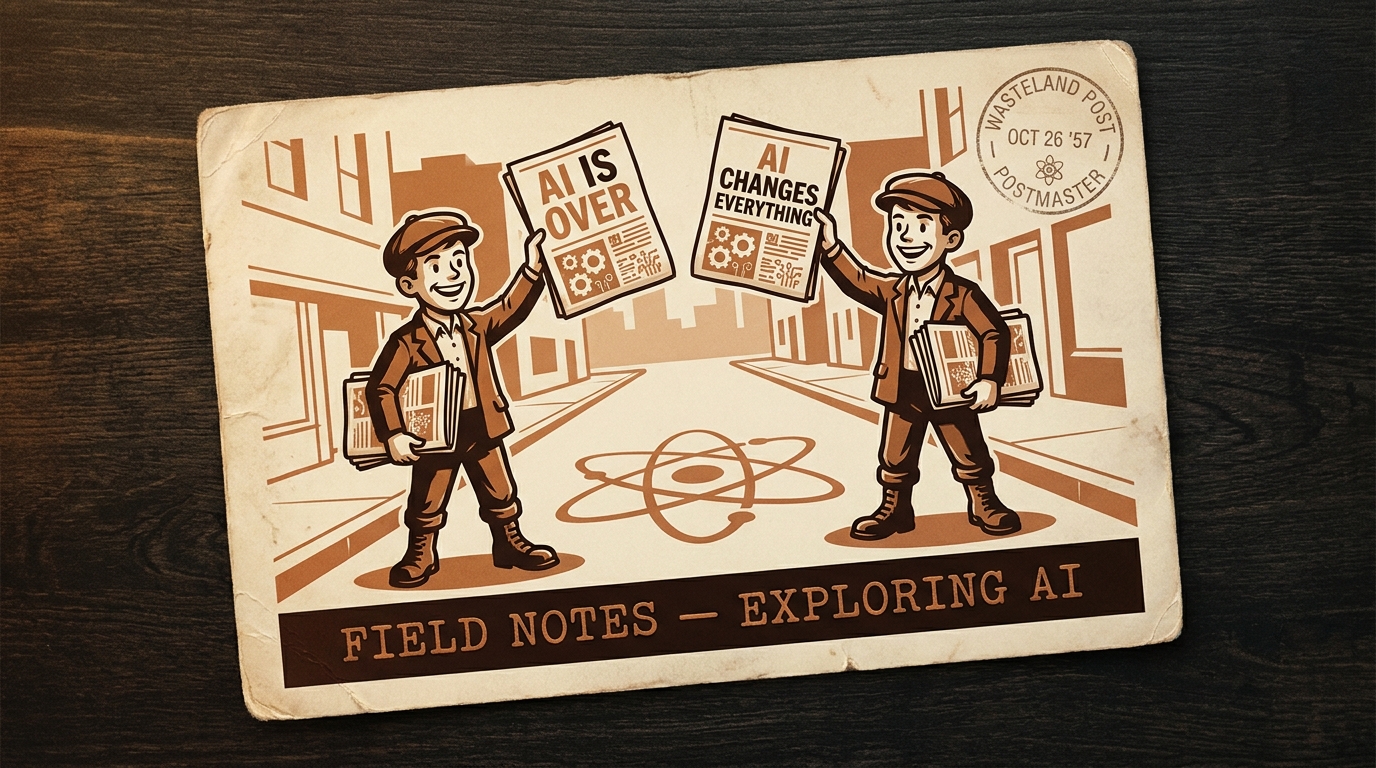
Every week, two types of content compete for your attention. On one side: industry surveys showing that professionals are skeptical, resistant, or simply not adopting AI tools. On the other: founders, vendors, and influencers announcing the next paradigm shift — usually by Thursday. Both are presented as signals worth reading. Both are structurally unreliable. And the collision between them is doing serious damage to a technology that doesn’t need the help.
This isn’t about individual bad actors or media sensationalism. It’s a structural problem — two systematic distortions operating simultaneously, each feeding the other, producing a public debate that tells you almost nothing about where AI is actually going.
The first distortion: asking the threatened
When a technology directly disrupts a profession, the people in that profession cannot be neutral observers. This isn’t a character flaw — it’s a predictable human response to existential pressure. Their assessments reflect a protection reflex, not an objective read of the technology’s trajectory. The two things are not the same signal.
This matters because a significant portion of what passes for “industry data” on AI adoption is built on exactly this foundation. Surveys asking practitioners whether they use AI, whether they trust it, whether they think it will transform their work — all of this measures anxiety levels with reasonable accuracy. It measures adoption trajectories poorly.
The pattern is not new. Photographers said digital would never replace film. Musicians said streaming would kill music. Journalists said algorithms couldn’t do editorial judgment. In each case, the verdict of those most threatened systematically underestimated the speed and depth of what followed. Not because they were wrong to be worried — but because proximity to the threat distorts the forecast.
Reading AI adoption surveys without this correction in mind isn’t rigorous analysis. It’s mistaking a thermometer for a compass.
The second distortion: the promise machine
The other side of the debate has a different problem. Vendors, influencers, and founders aren’t neutral either — they’re structurally obligated to sell a revolution every single day. Not out of dishonesty, but because their business model demands a constant flow of breakthrough content. The result is an echo chamber optimized for reach rather than truth, where features get framed as paradigm shifts and demos get mistaken for products.
The deeper issue isn’t the volume of promises. It’s the structural misalignment between the capital flowing into AI and the actual technological thesis. Capital doesn’t need to believe in the underlying fundamentals to enter a promising sector — it needs a credible story of returns. When those two things decouple, the technology ends up carrying the reputational risk of capital it never controlled.
Crypto illustrated this mechanism in full. The underlying thesis — decentralized trust, programmable contracts, censorship-resistant infrastructure — was serious and remains relevant. What destroyed its public credibility wasn’t a failure of the technology. It was the wave of opportunists who arrived specifically to exploit the hype: rug pulls, manufactured scarcity, exit schemes designed to extract money from people who genuinely believed in the project. They left the technology to carry the reputational cost of their behavior. The fundamentals didn’t collapse. The credibility did.
The post-covid games industry ran a smaller version of the same script. Capital flooded in chasing growth projections inflated by lockdown behavior. When the market normalized, the contraction was brutal — and the studios that had raised on those projections paid the price. Today, interactive world models are being sold as the imminent future of gaming before anyone has honestly addressed the gap between a compelling demo and a game someone would actually play.
When both distortions operate at the same time
What makes the current AI moment particularly difficult to read is that these two distortions aren’t operating in isolation — they’re feeding each other. The hype machine produces overclaiming, which enrages skeptics, who produce alarmist counter-narratives, which give vendors something to “correct,” which generates more content, more noise, and more polarization. The cycle runs on its own momentum.
The result is a public debate increasingly split between two camps: those who see AI as an unconditional revolution and those who see it as an unconditional threat. Both positions are stable because both are continuously reinforced. Neither is particularly useful for anyone trying to make real decisions about adoption, investment, or organizational strategy.
The actual risk
The fundamentals of AI are not in question. The technology works — in many domains, it works remarkably well, and the pace of improvement is not slowing. The risk isn’t that AI fails to deliver. The risk is that the promise machine discredits it before the fundamentals get the chance to prove themselves in the domains that matter most.
That risk is not abstract. Organizations making adoption decisions right now are doing so in an information environment where the most visible data points are either anxiety-driven resistance or overcalibrated enthusiasm. The cost of navigating that environment poorly — moving too slowly because the skeptics seem credible, or too fast chasing promises that don’t hold — is real and growing.
Knowing which voices to trust on AI right now requires understanding why almost none of them are structurally positioned to be neutral. That’s not cynicism. It’s the minimum viable filter for making sense of the debate.